
MOVIE TREATMENT
Title: Standup Comedy Time Traveler: Bombing Through History, One Joke at a Time
Tagline: The Setup Took 300 Years.
Genre: Sci-Fi Comedy / Historical Satire / Existential Farce
Tone: Bill & Ted meets Inside Llewyn Davis, with a dash of Drunk History and The Twilight Zone if Rod Serling ran an open mic.
LOGLINE
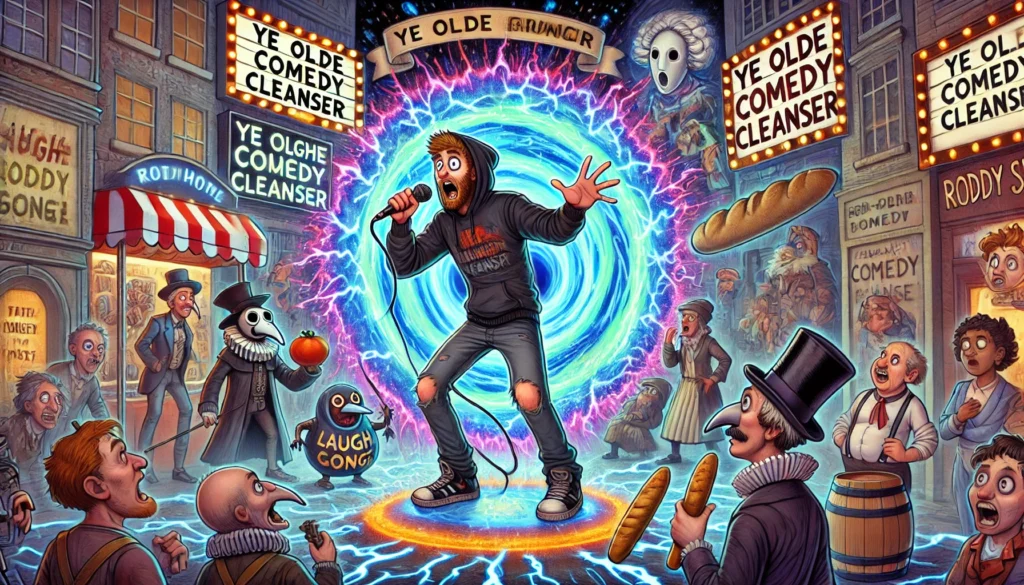
When struggling comedian and amateur inventor Roddy Slate accidentally time-travels via a malfunctioning sensory deprivation tank, he finds himself bombing onstage in the most unforgiving venues in history—from plague-ridden taverns and revolutionary salons to Martian open mics. As Roddy fights hecklers across centuries, he discovers the one thing more timeless than comedy… is dying onstage.
CHARACTERS
Roddy Slate – Mid-30s, sarcastic, self-deprecating, has one good bit about gluten and 300 bad ones about dating. Think Bo Burnham meets early Jim Carrey, with less charisma and more sweat.
Gretchen “Moonflower” Lutz – A 1970s poet/yoga instructor who becomes his accidental time-traveling sidekick after falling into his set—and his machine—during an open-mic in Haight-Ashbury. She’s brilliant, barefoot, and smells like patchouli and disappointment.
Sir Quentin Barleyfoot – A pompous 17th-century play critic who believes Roddy is a jester sent by Satan. Keeps popping up throughout time, always one step behind Roddy, like a cross between Inspector Javert and Statler from the Muppets.
Hologram Joan Rivers – Future A.I. comedy coach programmed with 30,000 hours of roast footage. She occasionally beams into Roddy’s mind with notes like “Tighter punchlines! Less dying!”
Time Machine (aka “The Set-Up”) – Made from a defunct tanning bed, Red Bull, copper wires, and Roddy’s shattered ambition. It time-hops based on audience energy and proximity to cheap stage lighting.
ACT I: THE SICK JOKE
Opening Scene:
Roddy bombs at a local bar called “The Laugh Trap.” His jokes about oat milk and ghosting land like a lead balloon. Desperate for inspiration, he heads to his garage and enters his janky “sensory deprivation tank” to “reset his mind.”
Cue zap-crackle-boom. He wakes up outside a 1667 London plague tavern, mid-performance, confused and covered in straw. He thinks it’s a renaissance fair. It’s not.
Roddy’s First Set:
Bombs immediately. No microphone, no stage lighting, no idea the Black Plague is trending. A friar throws holy water. A widow spits in his ale. A barrel of gin heckles him (possibly sentient).
He flees in terror, chased by peasants. Accidentally reactivates “The Set-Up” by stepping on a rotting lute and yelling “Is this thing on?!”
ACT II: THE SETUP THAT WON’T DIE
The Enlightenment (Paris, 1789):
Roddy crashes into a salon. He tries revolutionary material.
“Let them eat cake?” he says. “I can’t even afford crumbs!”
Gets booed for sounding bourgeois. Nearly guillotined. Redeems himself with anti-monarchist punchlines and gets booked by the Baker’s Union.
Backstage, he’s mistaken for Voltaire’s illegitimate nephew. Has an awkward flirtation with Marie Antoinette. She demands he perform for her cats.
Vaudeville America (1921):
Roddy appears onstage mid-routine. The crowd thinks he’s a “new act from the East.”
Starts with:
“My wife’s cooking could kill Mussolini.”
Big laughs.
But when he tries a proto-feminist joke, he’s pelted with cabbage.
He gets replaced by an act called “The Musical Ferrets.” Backstage, a producer tells him he’s “too thinky” and offers him $3 to sweep the stage.
Suburbia, 1950s:
Roddy’s stuck in the “Polite Joke” era.
“So a rabbi, a priest, and a vacuum salesman walk into a bar…”
The audience howls.
He riffs on therapy. A woman faints. A man in a gray suit mutters, “This is how McCarthyism started.”
FBI agents drag him offstage. Mid-tackle, the time machine sparks.
ACT III: TRIPPING THROUGH TIME
1973 San Francisco:
Roddy’s on acid (accidentally), performing at a commune open-mic. His routine about astrology and bowel movements becomes the foundation for modern slam poetry. George Carlin watches from a bean bag and nods.
Roddy gets invited to a free love ritual but declines, citing “emotional bloating.” A woman named Moonflower becomes obsessed with him. She sneaks into his machine. The two are now bonded across time, like Bill and Ted but smellier.
Historical Montage:
-
Performs for Alexander the Great. Is fed grapes. Misunderstands “tight set” as literal—wears a tunic too small.
-
Accidentally bombs during the Gettysburg Address. Lincoln tells him: “You should open with ‘Four score’ and close with ‘Never again.’”
-
Appears during Woodstock, mistaken for an experimental comedian. Performs 4 hours while a naked man paints his chest.
ACT IV: THE BIG REVEAL
Roddy and Moonflower land in a Netflix pitch room, 2025.
Executives love the idea of a time-traveling comic… until they ask for “diversity metrics” and “brand synergy with Taco Bell.” They offer a puppet version voiced by Werner Herzog.
Roddy declines, at first.
But Moonflower reminds him: “Comedy isn’t about control. It’s about connection… even if the audience is dead, or Victorian, or an AI toaster.”
Roddy takes the puppet deal. HBO Max greenlights “Jest in Time: The Roddy Slate Chronicles” — a docu-drama narrated by Herzog with marionette reenactments.
ACT V: THE CLOSER
The Year 2320, Mars:
Roddy steps onto a stage made of recycled SpaceX rockets. The Martian Dome Comedy Club is full of clones, androids, and one sarcastic octopus named Briney.
He opens:
“So I dated a clone. Now I pay crypto child support to six identical kids.”
One android chuckles. Briney snaps a tentacle in applause.
Roddy smiles. For once, the silence isn’t failure—it’s space.
Moonflower beams in via hologram: “You didn’t just change time, Roddy. You ruined comedy for every century equally.”
EPILOGUE: THE TIMELESS CLOWN
Roddy’s notebook, “Jokes from the Wrong Century,” becomes a cult classic. A viral meme shows him being booed in 1432 with the caption: “When you bomb so hard it becomes history.”
His quotes are etched into the walls of future comedy clubs:
“Timing is everything. Especially when you’re telling knock-knock jokes before doors are invented.”
“Never do crowd work in a feudal society.”
THEME
Comedy is the ultimate act of optimism.
Even when misunderstood, mocked, or martyred by tomato-throwing monks, the joke must go on. Roddy’s journey proves that standup is a noble pursuit — one where dying onstage is the only path to immortality.
CLOSING SHOT
Roddy, floating in a zero-gravity comedy club, delivering a punchline to a holographic crowd of historians, aliens, and standup holograms of Mitch Hedberg and Phyllis Diller.
They laugh.
Fade out on his smirk.
Title card: “Coming Soon to a Century Near You.”